
Mechanical Foam Fire Extinguisher Guide
Key Takeaways
- The Flammable Liquid Threat: Petrol, diesel, kerosene, paints, thinners, and industrial solvents ignite rapidly and spread horizontally across floor surfaces.
- The AFFF Mechanism: Aqueous Film Forming Foam blankets the burning liquid, floating on the surface to seal flammable vapors and prevent reignition.
- Never Use Plain Water: Water is heavier than fuel and will flash to steam underneath, causing explosive boiling and fuel splatter.
- Mandated Capacities: Available in 9-Litre portable cylinders (IS: 15683) and 45-Litre mobile trolley units (IS: 16018) for large manufacturing plants and fueling bays.
Flammable liquid fires—classified scientifically as Class B fires—represent some of the most violent, fast-spreading emergencies encountered in chemical plants, oil refineries, fuel stations, spray-painting booths, and automotive workshops. When hydrocarbons like diesel, solvents, or paints ignite, they release volatile vapors that create blinding, high-temperature heat plumes.
In these high-risk environments, standard water fire extinguishers can be fatal if applied, and dry chemical powders may allow dangerous vapor flashback once the powder settles. The undisputed gold standard for hydrocarbon fire suppression is the Mechanical Foam (AFFF) Fire Extinguisher.
The Science Behind Aqueous Film Forming Foam (AFFF)
A Mechanical Foam extinguisher discharges a carefully proportioned mixture of water and synthetic fluorinated surfactant foaming concentrate known as Aqueous Film Forming Foam (AFFF). When discharged through an air-aspirating foam branchpipe or specialized nozzle, the solution entrains air, expanding into a thick, uniform foam blanket.
Extinction occurs through a three-stage thermodynamic process:
- Vapor-Sealing Aqueous Film: A microscopic aqueous film drains from the foam blanket and spreads rapidly over the fuel surface, even on lower surface tension hydrocarbons. This film acts as an impenetrable physical barrier that stops volatile vapors from escaping into the air.
- Oxygen Starvation (Smothering): The blanket of foam covers the fuel entirely, cutting off atmospheric oxygen required to sustain combustion.
- Sensible Cooling: Because the foam solution consists of over 94% water, it absorbs intense thermal energy from the fuel surface, dropping the fuel below its autoignition flashpoint.
| Fire Extinguishing Agent | Primary Fire Classes | Vapor Blanket / Flashback Protection | Cleanup & Residue | Electrical Safety |
|---|---|---|---|---|
| Mechanical Foam (AFFF) | Class A (Solids) & Class B (Liquids) | Superior (Permanent aqueous film prevents reignition) | Liquid foam residue (Washable with water) | Conductive (Not safe on live circuits) |
| ABC Dry Chemical Powder | Class A, B, C & Electrical | Moderate (Flashes back if fuel remains hot after powder settles) | Heavy abrasive chemical dust | Non-conductive up to 1000V |
| Carbon Dioxide (CO2) | Class B & Electrical | Low (Gas disperses into the air quickly outdoors) | Zero residue (100% clean gas) | Safe on high-voltage equipment |
| Plain Water (Stored Pressure) | Class A ONLY | Extremely Dangerous (Causes violent fuel slopover) | Water runoff | Severe shock risk |
Why Water Must NEVER Be Used on Flammable Liquid Fires
It is critical for plant operators, safety managers, and warehouse supervisors to understand why plain water is strictly prohibited on liquid fuel fires:
- Density Mismatch: Petroleum hydrocarbons have a specific gravity of 0.72 to 0.85, making them substantially lighter than water (1.0). When water is sprayed onto a fuel pool, it sinks straight to the bottom.
- Explosive Steam Expansion: Liquid fuels burn at temperatures exceeding 400°C to 800°C. Water trapped beneath boiling fuel instantly vaporizes into steam, expanding to 1,700 times its original volume. This violent phase change causes a phenomenon known as "slopover" or "boilover", catapulting blazing fuel drops 10 to 20 meters across the workspace.
- Spreading the Flame: Runoff water flows across factory floor channels, carrying burning oil across drains and igniting adjacent machinery.
AUREX Mechanical Foam Range: Built for High-Risk Environments
Aurelius Groups manufactures premier stored-pressure mechanical foam fire extinguishers compliant with Bureau of Indian Standards mandates:
1. 9-Litre Portable Foam Extinguishers (IS: 15683)
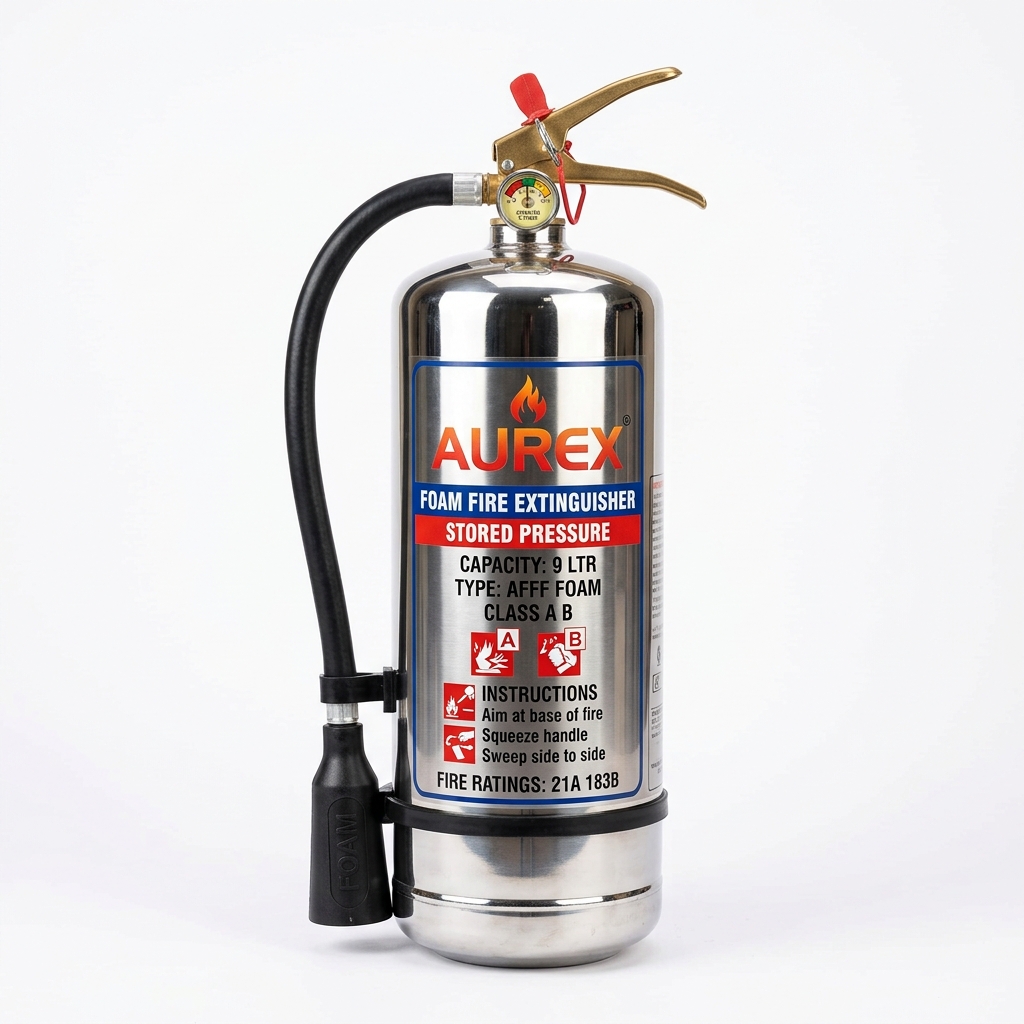
Our 9-litre units are the backbone of indoor chemical storage rooms, paint shops, boiler rooms, and petrol retail outlets. Available in both durable red powder-coated Mild Steel (MS) and premium mirror-polished Stainless Steel (SS 304) bodies. Stainless steel bodies offer superior corrosion resistance in humid, coastal, or aggressive chemical environments where standard cylinders risk rusting from inside out.
2. 45-Litre Mobile Foam Trolley Units (IS: 16018)
For industrial fuel storage yards, bulk chemical dispatch gantries, paint manufacturing tanks, and helicopter landing pads, a 9-litre unit is insufficient. The AUREX 45-litre mobile trolley features:
- Heavy-duty rubberized pneumatic wheels and balanced steel chassis for one-person rapid transit.
- 5-meter high-pressure wire-braided discharge hose with a heavy-duty stainless steel foam branchpipe.
- Massive fire rating of up to 55B / 89B, capable of extinguishing wide-area fuel spillages within seconds.
Upgrade Your Facility's Class B Fire Protection
Protect your fuel storage, chemical tanks, and paint workshops with BIS-approved AUREX 9L portable and 45L mobile trolley foam fire extinguishers.
VIEW FOAM EXTINGUISHER RANGECorrect Technique for Discharging a Foam Extinguisher
Applying mechanical foam requires a specific technique to ensure the vapor-sealing blanket remains intact:
- Do Not Plunge Directly into the Liquid: Never point the nozzle straight down into the center of a fuel pool. High-pressure discharge will splash burning fuel over the edges and break up the foam blanket.
- Bounce the Foam: Aim the discharge nozzle at the back wall of the container, steel machine casing, or a vertical barrier behind the fire. Allow the foam to gently cascade down and roll smoothly across the burning fuel.
- Gentle Sweeping Arc: If tackling an open spill with no vertical backstop, stand at a safe distance (minimum 3 to 4 meters), point the nozzle upward, and allow the foam to rain down softly in a continuous sweeping arc.
- Maintain the Blanket: After the flames disappear, continue applying foam until the entire liquid surface is blanketed under at least 25mm to 50mm of continuous foam layer. Do not walk through the blanket!
Inspection & Maintenance Checklist Under IS: 2190
Because foam solutions are aqueous and organic, they require diligent periodic testing to ensure optimal expansion performance:
- Monthly Pressure Verification: Confirm that the pressure gauge needle sits firmly within the green operational band (typically 12 to 14 Bar).
- Nozzle Inspection: Ensure the air-aspirating holes on the foam branchpipe are completely free of cobwebs, dirt, or dried paint splatters.
- Annual Solution Refill: Under IS: 2190, the AFFF foam charge must be thoroughly replaced annually to avoid biological degradation or chemical settling.
- Statutory Hydro-Pressure Test: Every 3 years for mechanical foam cylinders, the body must undergo hydraulic pressure testing at 30 Bar to verify cylinder wall integrity.
Frequently Asked Questions (FAQ)
Q: How does a Mechanical Foam (AFFF) extinguisher put out flammable liquid fires?
When discharged through an aspirating nozzle, the aqueous film forming foam (AFFF) concentrate mixes with air to create an expansive, low-density foam blanket. This foam floats directly on top of burning hydrocarbon fuels (petrol, diesel, oils, paint thinners). The aqueous film acts as an airtight vapor barrier, cutting off atmospheric oxygen and cooling the fuel below its flashpoint, permanently preventing reignition.
Q: Why can you never use water on a Class B flammable liquid fire?
Water is denser than oil, petrol, and diesel. If sprayed onto burning fuel, water instantly sinks to the bottom of the container or puddle. Because the fuel temperature is far above 100°C, the water flashes into steam beneath the fuel, causing an explosive boilover (slopover) that violently ejects blazing liquid into the air and spreads the fire uncontrollably.
Q: Can Mechanical Foam extinguishers be used on live electrical equipment?
No. Standard mechanical foam solutions contain water and conductive foaming salts. Discharging foam onto energized high-voltage electrical equipment carries a severe electrocution hazard for the operator. For electrical fires, always use non-conductive CO2, Clean Agent, or specialized water mist units.
Q: What is the difference between a 9-Litre portable foam unit and a 45-Litre foam trolley?
A 9-Litre stored-pressure foam extinguisher is portable (designed for rapid manual handling on localized spills up to 5-10 meters away per IS: 15683). A 45-Litre mobile trolley unit (built per IS: 16018) features heavy-duty wheels, high discharge volumes, and an extended 5-meter reinforced hose, specifically designed for large industrial fuel storage yards, petrochemical refineries, paint mixing plants, and fuel stations.


